MP vs. MCA: Decoding Kenya’s Government to Empower Our Community
When election season arrives in Kenya, the noise is deafening. Manifestos are launched, promises are made on busy street corners, and posters cover every available surface. But amidst the rallies and rhetoric, a fundamental confusion often persists for the average voter: What exactly is the difference between a Member of Parliament (MP) and a Member of County Assembly (MCA)?
If you don’t know who is responsible for fixing your local sewer line versus who handles national education policy, you are not alone. This confusion is a massive barrier to effective civic engagement.
At Protect Girls Image Organization, we believe that true empowerment—especially for women and girls—start with understanding the systems that govern our lives. If we want to advocate for safer streets, better schools, and fair representation, we must know which leader holds the power to make it happen.
This guide will demote the roles, clear the confusion, and show you exactly how to hold your elected leaders accountable.
The Gray Areas: Why the Confusion Exists.
If the roles of MP and MCA are legally distinct, why are voters so confused? The primary reason is that the roles overlap in their visible output.
In the mind of many voters, an elected leader is “the person with resources”. Both MPs and MCAs control public funds for development. When a new school laboratory is built, a new community water point is installed, or a local road is paved, the project might be funded by the national government (via the MP) or the county government (via the MCA).
Because both leaders “deliver development”, voters often view them simply as sources of patronage, ignoring the critical legislative and oversight functions that define their actual jobs. This blurred perception is often exploited during campaigns, where a candidate for MP might promise to build a local clinic (an MCA function) just to win votes.
Decoding the Roles: National vs. Local
To move past the confusion, we must understand the core responsibility of each office.
What is a Member of Parliament (MP)?
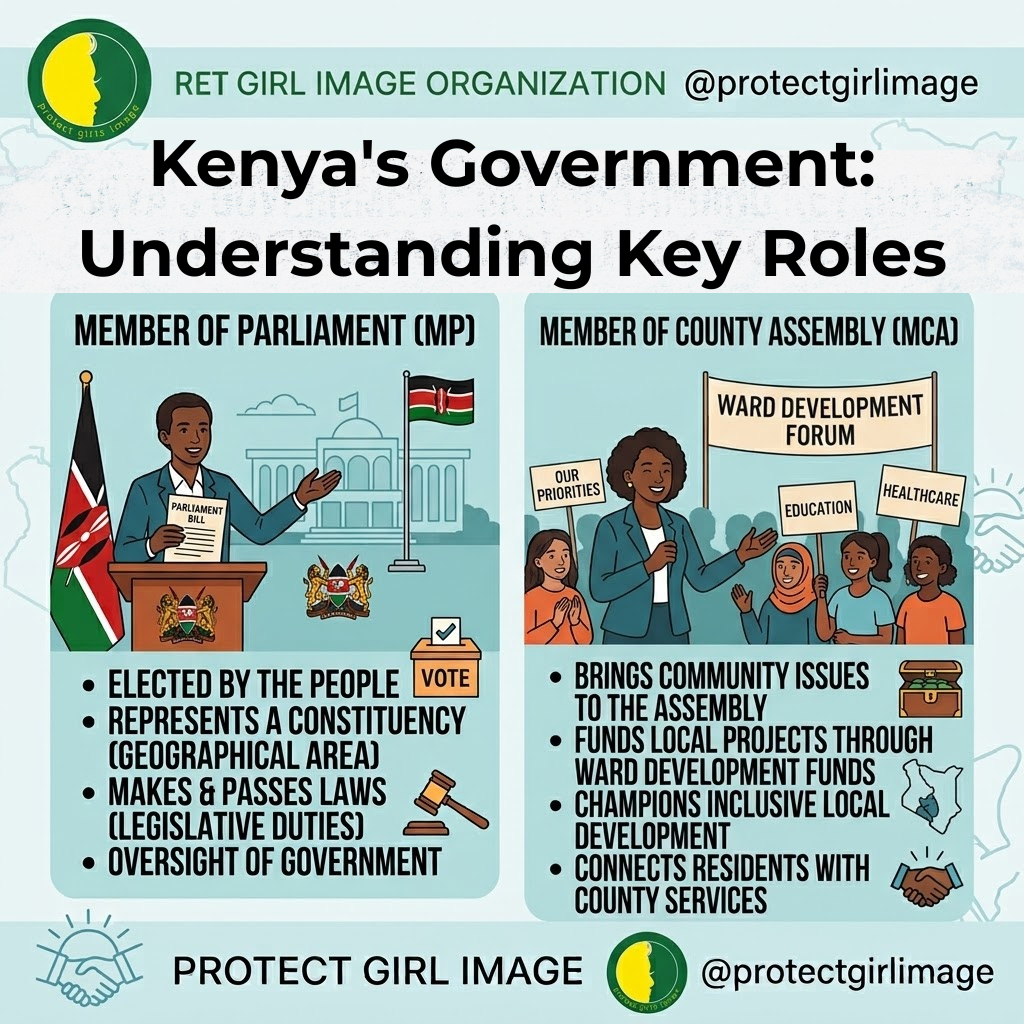
An MP is a representative at the national level. Kenya has a bicameral parliament, consisting of the National Assembly and the Senate. When people say “my MP”, they are usually referring to their representative in the National Assembly.
Key Responsibilities:
- Legislation: Debating and passing laws that affect the entire country.
- Oversight: Holding the national executive branch (the President and Ministries) accountable.
- Representation: Bringing the views and needs of their specific constituency to the national stage.
- Budgeting: Approving the national budget and allocating funds to national ministries.
- CDF control: MPs manage the National Government Constituencies Development Fund (NG-CDF), which funds specific community-level projects.
Think of an MP when the issue is: National security, education policy (curriculum, teacher employment), national highways, large-scale infrastructure, or changes to national laws.
What is a Member of County Assembly (MCA)?
An MCA is our representative at the county level. Kenya is divided into 47 counties, each with its own devolved government.
Key Responsibilities:
- Local Legislation: Passing “by-laws” and regulations specific to their county.
- Devolution Oversight: Holding the County Governor and county executive departments accountable.
- Community Representation: Advocating for the specific needs of their Ward (the smallest electoral unit).
- County Budgeting: MCAs often influence or manage specific Ward-level development funds.
Think of an MCA when the issue is: Local roads, garbage collection, water supply, markets, street lighting, early childhood education (ECDE), local health clinics, and agricultural extension services.
The Political Career Ladder: The Steppingstone
There is a clear political career ladder in Kenya, and the MCA position is often the starting point.
Because an MCA represents a smaller, more intimate Ward, it is a position that can be won with strong local connections, community organizing, and a smaller campaign budget. It allows aspiring leaders to gain experience in legislation, budgeting, and public service.
Many prominent Kenyan politicians began their careers as MCAs (or their equivalent in previous systems). For ambitious leaders, an MCA seat is a crucial steppingstone. A successful MCA can build a reputation that allows them to run for MP, then Senator or Governor, and perhaps even national leadership.
Accountability Questions: Holding Them to Their Word
The single most important step in understanding our government is moving from “What can you give me?” to “How have you done your job?”
We must stop accepting empty, grand promises and start asking sharp, accountability-focused questions. Use these questions to evaluate both current leaders and candidates:
Question for the MP (or MP Candidate)
- On Legislation: “In the last term, what national bill did you sponsor or support that has a direct, positive impact on our constituency? How did you vote on the e.g. finance bill, affordable housing levy or any other specific controversial law.
- On CDF Transparency: “Can you provide a line-item budget for the use of the NG-CDF in our constituency for the last year? How are community priorities selected for funding?”
- On National Advocacy: “Which national ministry have you actively petitioned to address the lack of e.g. employment among youths, femicide, secure roads, etc. in our area?”
Questions for the MCA (or MCA Candidate?)
- On Local Service Delivery: “Our market has had no running water for six months. What specific steps have you taken in the County Assembly to compel the water department to act?”
- On County Budgeting: “I noticed a significant allocation in the county budget for (Specific Expense e.g. bursary). Did you support this, and how many of our children are being considered for them, and what is the criteria of choosing the beneficiaries?”
- On Oversight: “When the county Auditor’s report flagged missing funds in the health department, what did you do as a representative to ensure accountability?”
Call to Action: Be an Informed Citizen
Understanding the difference between an MP and an MCA is not just academic; it is the key to unlocking the potential of devolution. When we know who is responsible, we know who to petition, who to lobby, and who to hold accountable.
As part of the Protect Girl Image Organization, we urge you to use this knowledge. Join your local Ward Development Forum. Attend citizen participation meetings for the county budget. Demand transparency.
Our community’s development depends not on the promises of politicians, but on the vigilance of its citizens.
Share this guide to empower your friends and family!
Written by Lydia Mwangi